Life After Cancer, Where do you Even Start?
May 17, 2026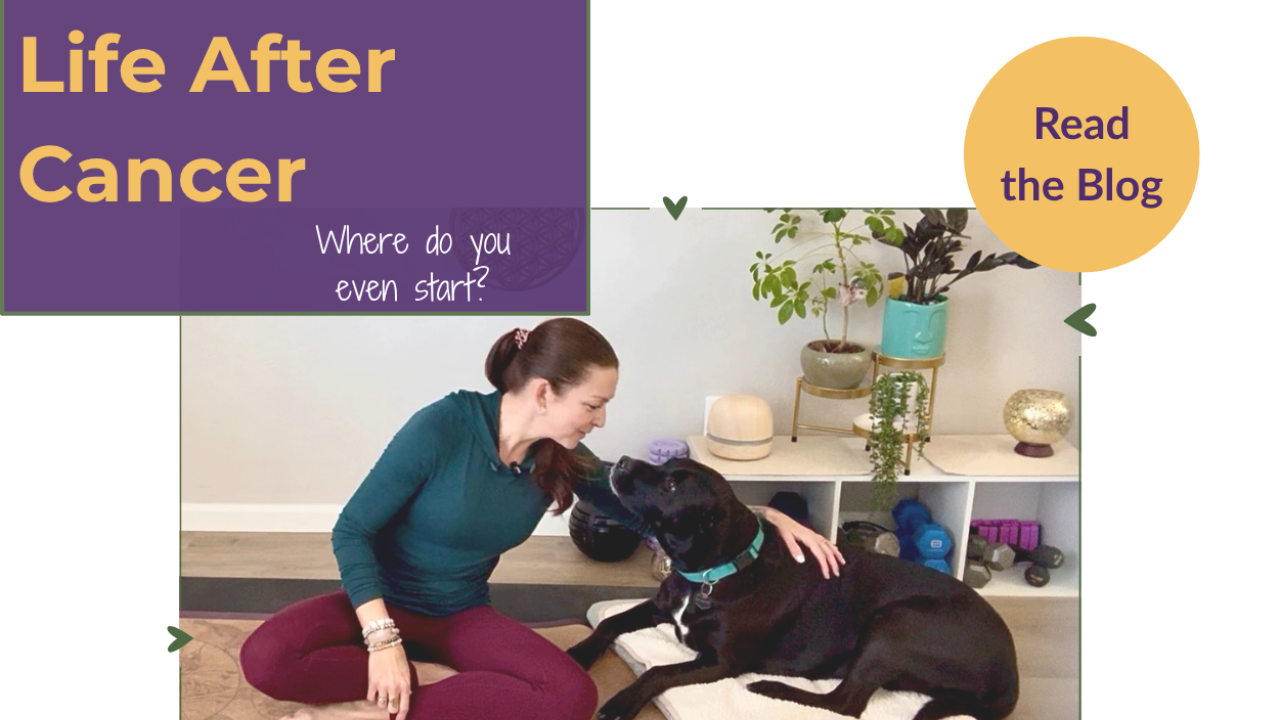
Life After Cancer: Where Do You Even Start?
The honest, real-human guide to starting again when treatment ends and nobody hands you a roadmap.
For a long time after my treatment ended, I sat on the edge of my bed in a tiny apartment above a garage and asked myself the same quiet question every morning.
"What now?"
Not in a hopeful, the-world-is-my-oyster way. More in the disoriented, slightly numb way. The appointments had slowed down, the adrenaline was gone and, the medical system had quietly stopped checking on me. I was also left in a body I didn't recognize, with a life that didn't fit, holding the question I think every cancer survivor eventually has to face on their own:
Now what do I actually do?
If you are sitting somewhere right now asking yourself that exact question, I want to say first that it makes complete sense for you to feel this way. You have never lived life after cancer before. Of course you do not know where to begin. Nobody actually walked you through what survivorship is supposed to look like, because the people in your orbit during treatment were not really set up for that conversation. Your oncology team's job was to keep you alive, and they did. The wellness influencers in your feed were busy selling you green powder. The well-meaning friends who said "you must be so glad it's over" were trying to wrap a bow around the whole experience, not realizing you were nowhere close to being on the other side of it. The disorientation you are feeling is not a personal shortcoming, it's the very reasonable response of a human being who has walked out of treatment and found nobody handed them a map.
This is the survivorship phase of cancer and it is the most under-supported chapter of the entire journey.
The Three Chapters of Cancer Nobody Talks About in Order
Cancer divides your life into three distinct chapters, and most of the world only ever talks about the first two.
There is the diagnosis, when everything you thought you knew about your life cracks open in a single sentence from a doctor's mouth.
There is treatment, the fire itself. The surgeries. The medications. The scans. The exhaustion. The survival mode that demands every ounce of energy you have. This is the chapter where casseroles arrive on your doorstep, where people ask how you are, where the medical system has a clear plan for you.
And then there is survivorship. The chapter that begins the day treatment ends and continues for the rest of your life. The chapter where the casseroles stop arriving. Where people stop asking. Where the medical system quietly says "see you at your six-month scan" and you walk out of the hospital with no rehab plan, no nutritional guidance, no mental health follow-up, no support group, and no real instructions for how to live in this new body and this new life.
This is where I lost the better part of four years.
The Survivorship Gap is Real
Here is what nobody tells you about life after cancer treatment.
After four major abdominal surgeries, each lasting over five hours and involving the removal or destruction of delicate, life-sustaining organs, I was given nothing. No physical therapy referral, no pelvic floor evaluation, no survivorship care plan, no mental health resources and no nutritional support. Years later, still in agonizing daily pain and barely able to work, I finally found a pelvic floor physical therapist who took one look at me and could not believe nobody had referred me sooner.
I am not the exception, I am the rule.
After a knee surgery, doctors prescribe physical therapy, regular check-ins, and a clear rehabilitation plan. After cancer, which is arguably the most full-body trauma a person can survive, most people are sent home with a follow-up scan calendar and a kind handshake. The medical system does an extraordinary job of saving your life, and then it stops. It is not built to help you live in your body after.
This gap has a name in the research literature... the survivorship gap, and it has been documented for decades. It is a structural problem in how cancer care is designed. The fact that you are sitting here, post-treatment, wondering where to begin is evidence that the system left a roadmap missing, not that you did something wrong.
So Where Do You Actually Begin?
When I finally stopped waiting for somebody to hand me a plan and started building one myself, three small things became the foundation of what eventually became The Cancer Comeback Club.
I came to call them The Three Anchors of Survivorship.
Movement. And when I say movement, I do not mean exercise in the way that word usually shows up online, or a structured workout plan, or anything that asks your post-treatment body to perform for you. I mean something gentler and more intentional than that. The kind of movement that reminds your nervous system how to recruit muscles again, rebuilds the foundational strength that long hospital stays and surgery quietly stripped away, and slowly makes daily life feel a little less like a negotiation with gravity. Getting out of a car, lifting a grocery bag, walking up the stairs, all of that starting to come back to you without thinking about it. As an NASM Certified Personal Trainer and Corrective Exercise Specialist, I built my own program from the floor of a tiny apartment after my own surgeries, the most important thing I can tell you about post-cancer movement is this: it is not about doing more, it is about doing the right small things consistently.
Reflection. Survivorship is not just a physical rebuild, it is an identity rebuild. Cancer rewires how you see your body, your time, your relationships, and your future. Putting structured prompts in front of yourself, even tiny ones, helps your nervous system regulate, helps your brain notice progress instead of only scanning for danger, and helps you slowly become the next version of yourself instead of waiting to feel like the old one again. Neuroscience research shows that simply writing down what you are proud of activates the reward centers in your brain and builds new neural pathways for safety, capability, and progress. That is not woo woo, that is rewiring after trauma.
Food for Healing. And to be clear, I am not talking about a diet, a cleanse, or a 30-day reset with a powder and a meal plan and a guilt trip. I am talking about real, repeatable nutritional support that helps your body do the long, quiet work of cellular repair, hormone balance, and immune resilience. As a Plant-Based Nutritionist trained through eCornell's program based on the T. Colin Campbell research, I will never sell you a powder, a perfect protocol, or a list of forbidden foods. The most healing thing you can do nutritionally after cancer is feed yourself consistently, gently, and without punishment.
These three anchors are exactly what your body and your nervous system actually need in the re-entry phase of life after cancer.
Meet The Cancer Comeback Club
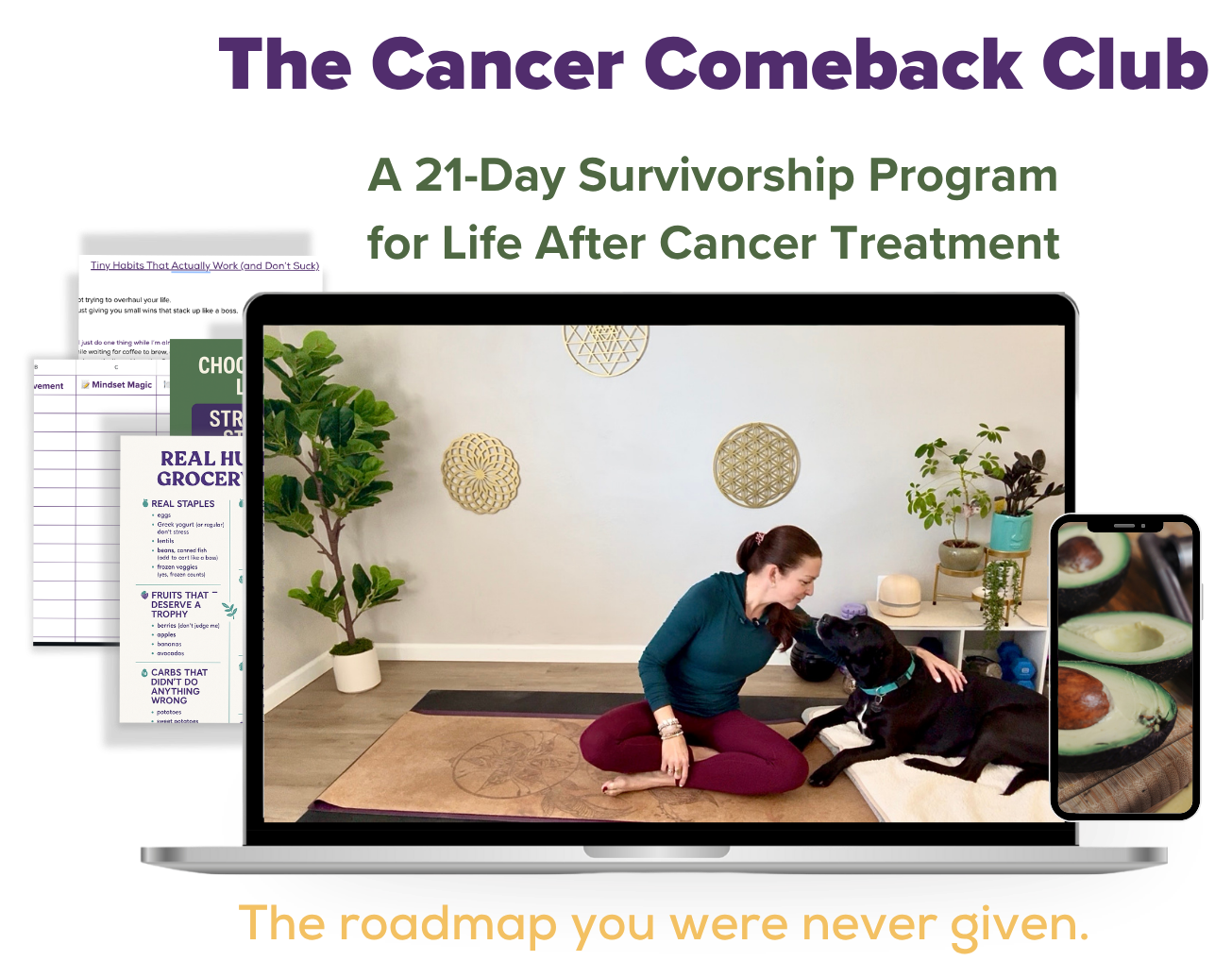
The Cancer Comeback Club is the structured 21-day re-entry program I built for survivors who are sitting where I sat. It's the survivorship roadmap I wish somebody had handed me the day my treatment ended.
Every day inside the program is built around the Three Anchors — one supportive movement, one reflection prompt, one food for healing — and is paced for real human beings in real cancer recovery, including the days you are exhausted, in pain, or quietly questioning whether any of this matters. You can do it from your bed if you need to, you can repeat days and, you can take a week off. The program is designed for the actual unpredictability of survivorship, not a fantasy version of it.
Inside the program you will also find 🐾Ernesto, my 88-pound rescue dog and unofficial healing assistant. He appears in all of the videos, supervises some, and represents one of the most important things I learned in my own recovery: comebacks are easier when a beating heart is sitting beside you.
A Note for the People Who Hold Survivors
If you love a survivor, send this to them. The hardest thing about survivorship is how invisible it is from the outside. The version of them that is still quietly trying to find their way back is the version who needs to be handed a roadmap.
If you are a hospital, an oncology team, a cancer center, or a survivorship program looking for real survivorship programming for your patients, including group cohorts, workshops, retreats, or long-term partnerships, I would love to talk. The Cancer Comeback Club was built specifically because the medical system gave me no plan, and my mission is to make sure no other survivor leaves treatment with the same empty hands.
If you are a corporate wellness program, an HR leader, or an executive who knows your company quietly employs survivors who are returning to work after one of the hardest chapters of their lives, the Cancer Comeback Club has corporate licensing and group cohort options. Survivors returning to work are usually navigating a complete identity rebuild on top of the daily demands of their job. Real, structured support changes everything.
Where You Begin
You begin right here, in whatever this current moment looks like for you.
You begin with one supportive movement, one tiny act of nourishment and, one honest question put to yourself on paper. You begin by deciding that the chapter after cancer is not something you are passively waiting for, it's something you are actively building.
I built mine in a tiny apartment above a garage with 🐾Ernesto curled up at my feet. You will build yours wherever you are, exactly as you are.
The roadmap exists now. Come find your comeback with me.
💜 Sara and 🐾Ernesto
Sara Broome is a colon cancer survivor, NASM Certified Personal Trainer, Corrective Exercise Specialist, and Weight Loss Specialist, Plant-Based Nutritionist (trained through eCornell's T. Colin Campbell Center), Cancer Wellness Coach, and the founder of The Cancer Comeback Club, a 21-day survivorship re-entry program for life after cancer treatment.She partners with hospitals, cancer centers, foundations, and corporations to deliver structured post-treatment survivorship programming, group licensing, workshops, retreats, and keynote talks on cancer recovery and life after cancer. She lives somewhere quiet with the love of her life, a rescue dog named 🐾Ernesto.
Learn more about the Cancer Comeback Club, a 21 day survivorship re-entry program, by clicking below!
Love The Cancer Comeback Conversations?
💌 Join The Sara & 🐾 Ernesto Drop-In
Real-life updates on movement, food for healing, and survivorship after cancer… shared when energy allows, because healing doesn’t follow a schedule.
👉 Subscribe to The Sara & 🐾 Ernesto Drop-In
We hate SPAM. We will never sell your information, for any reason.